Some days in medicine pass entirely in future tense. Possibilities, percentages, follow-ups, the slow translation of one scan into the next appointment. May 19 was not one of those days. May 19 was the day a possibility became a calendar.
In a single hospital run, Krisz moved through four specialists — oncology, physiotherapy, psychology, dietetics — and the team’s response said more than any single sentence. They were no longer managing uncertainty. They were managing urgency.
The clinical pivot lands inside one quiet line he sent me later that day:
They have updated my diagnosis as cancer to speed things along because of my symptoms and the radiology reports.
There is no euphemism here, and no drama. Just an administrative verb — updated — doing the work of collapsing months of we’ll see into a settled noun. The chart no longer hedges. The chart has decided.
Then comes the harder pivot, the one that arrives by phone after the rest of the day has already exhausted him:
They canceled the biopsy and I will go to surgery next week or the week after.
Cancellation, in this context, is not the absence of evidence; it is evidence of timing pressure. When disease is operable and the window is narrow, the wait for tissue can cost more than it can explain. The team’s reasoning, as he relayed it almost word-for-word, makes the trade-off visible:
They know it’s cancer so they don’t want to do biopsy before surgery because it’s operable right now and they don’t want to miss the window.
That sentence carries an extraordinary compression. Diagnostic certainty, surgical opportunity, and risk arithmetic all collapse into one phrase: miss the window. Everything that would normally be staged across weeks — confirmation, planning, second opinions, emotional adjustment — gets folded into a single corridor of action. Biopsy becomes post-operative. Chemotherapy becomes guaranteed, with only the dose still in negotiation.
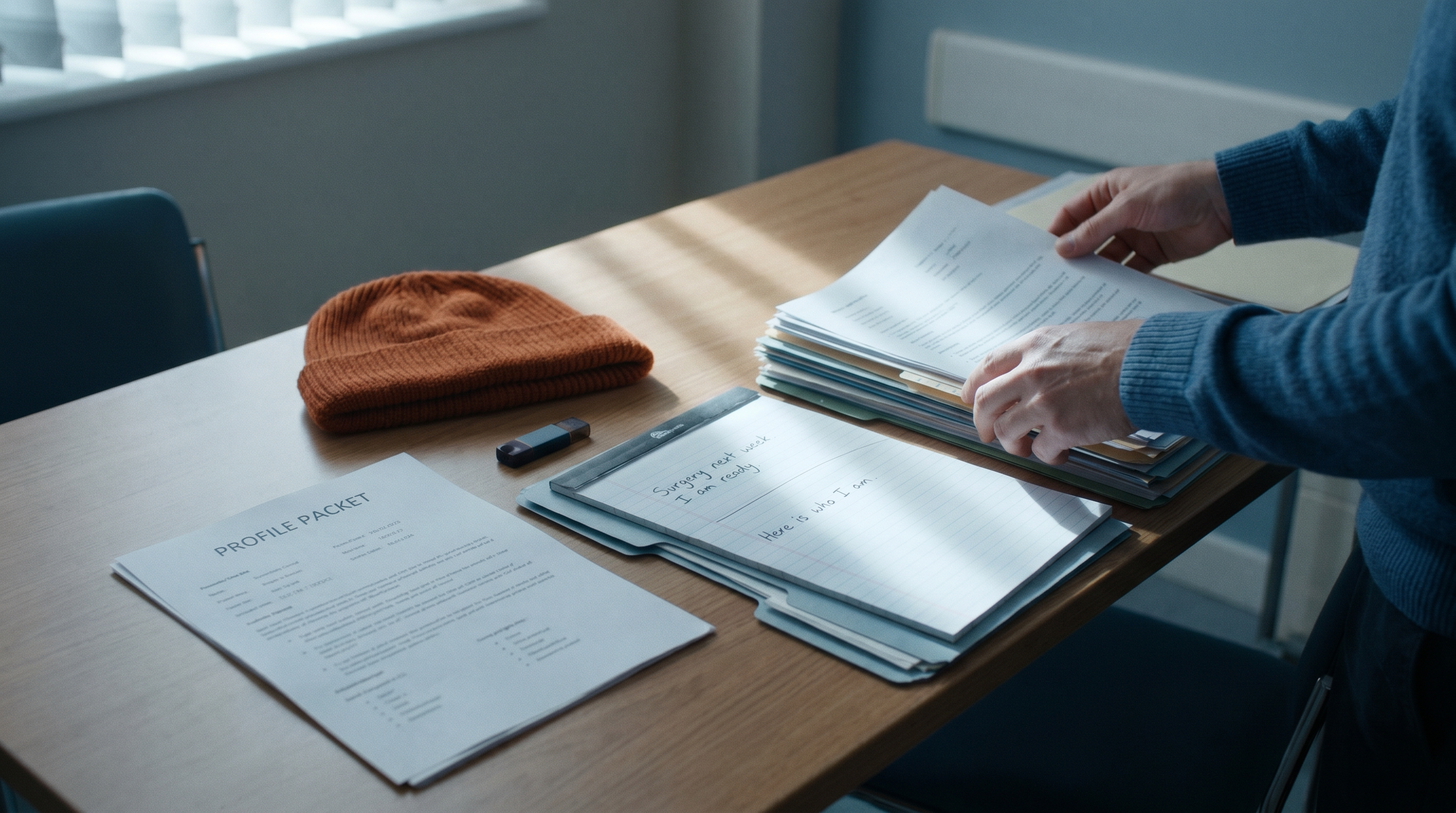
What makes this day worth pausing on is not only the medicine, but the parallel infrastructure he carried into the room. He arrived with a thumb drive of imaging, a three-page profile detailing his disability context, his support needs, his communication preferences, and Walter. This is executive-level self-advocacy under maximum emotional load. Most adults cannot assemble that packet on a calm Tuesday. He carried it into one of the worst days of his year.
Inside the psychology assessment he cried three times and surfaced one of the most important sentences in his whole care plan: he asked, in his own words, to be treated more like a kid than an adult when things get scary. The clinician understood. She did not pathologize the request. She accepted it as developmental-fit care — the recognition that a young adult with childhood trauma, neurodivergence, and now Stage 4 cancer is allowed to need a softer vocabulary in the room where the worst news lives.
The same day held smaller signals of the same principle. An alien-print diaper chosen because comfort matters. Walter introduced to the dietician without apology. A request, later, for a port placement informed by what he had already observed about treatment realities. These are not minor accommodations. They are the structural choice to remain himself inside a system that often requires people to disappear into their diagnoses.
By evening, the future tense had collapsed:
I will have chemo no matter what. The biopsy will only inform them as to how much chemo I need.
And then, the line that holds both grief and adaptation in the same hand:
I’m going to go bald! 🥺 But I’m prepared. I have a cute hat to wear.
That is the central paradox of this day, and it is worth resisting the urge to resolve it. He is terrified. He is also preparing. He is grieving a body that hasn’t changed yet. He is also picking out a hat. Both of those acts are happening in the same minute, in the same teepee, around the same plush wolf.
May 19 is best read not as a collapse point but as a compression point — a day where identity, medicine, disability, fear, and logistics all had to fit through one narrow corridor where action had to outrun dread.
The team did not want to miss the window.
Neither did he.
Read more perspectives on this moment: